Beauceron Security – AI-enabled deterrence system for after-hours protection
Beauceron Security
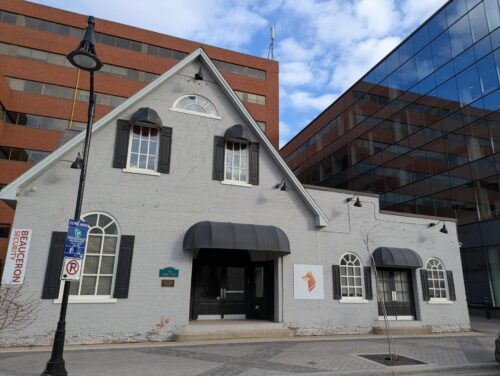
Beauceron Security is a Canadian B2B SaaS cybersecurity company serving more than 1,000 organizations globally. Headquartered in a historic downtown property, the company maintains an active in-office presence to support team collaboration and community engagement.
Headquarters
Fredericton, New Brunswick
Employees
11-50
Founded
2015
Industry
Cybersecurity SaaS
Facility Type
Downtown Commercial Office
Scope of Systems
AI-Enabled CCTV / Active Deterrence
Technology Partner
Alarm.com
- Proactive deterrence without live monitoring overhead
- AI-generated voice responses tailored to real-time activity
- Flexible deployment to suit existing infrastructure
- Clear local accountability from planning through support
Why Beauceron Security chose QSA
Beauceron Security sought a solution that could move beyond passive video recording and help address ongoing after-hours activity around its downtown Fredericton office.
While a traditional CCTV system was already in place, leadership recognized that recording incidents after the fact was not enough. The goal was to discourage unwanted behavior early – without increasing staff workload or relying on constant live monitoring.
QSA was engaged to design and deploy a solution that could:
- Provide visible, real-time deterrence
- Reduce repeat loitering and after-hours activity
- Integrate cleanly with existing infrastructure
- Remain simple to manage and scalable over time
Rather than layering on complexity, the focus was on configuring technology to respond appropriately to real-world conditions.
“The difference was moving from passive recording to proactive deterrence. It changed the way we think about protecting the property.”

Challenge
Moving from passive recording to active deterrence
Beauceron’s downtown location had experienced repeated after-hours activity in adjacent exterior areas. While cameras were installed and signage was present, the system functioned primarily as a recording tool.
Operational realities included:
- Ongoing loitering in exterior corners and entry areas
- Manual review of footage when incidents occurred
- Limited ability to intervene in real time
- Staff concerns about safety when arriving or leaving the office
Traditional deterrence methods – including signage and standard alarm triggers – did not consistently discourage activity.
Leadership sought a solution that would:
- Respond immediately when activity was detected
- Create the perception of live monitoring
- Reduce the need for manual oversight
- Avoid excessive false alarms
- The objective was not escalation, but early intervention
Solution
AI-enabled deterrence configured for real-world conditions
QSA recommended and installed an Alarm.com AI Deterrence (AID) camera system, integrated with the client’s network infrastructure.
The deployment included:
- Network-powered AI deterrence cameras deployed using existing high-power POE infrastructure (POE++)
- Integration with the Alarm.com platform
- Configured video analytics with AI-generated voice-down messaging
- Active strobe and siren capability
- Custom recording and notification rules
The system was configured to detect human presence in defined zones during specified after-hours windows. When triggered, the camera analyzes the scene and delivers an AI-generated verbal response referencing clothing and location – creating the impression of live two-way monitoring.
Unlike traditional fixed audio warnings, AI-generated responses adapt to the situation, reinforcing the perception of direct engagement.
Calibrated to reduce nuisance alerts
To minimize false triggers, QSA calibrated detection zones and timing thresholds based on site conditions. For example:
- Adjusted dwell-time thresholds to avoid triggering on brief pass-through traffic
- Tuned analytics to distinguish between environmental movement and human presence
The system includes built-in limits on AI-triggered voice events per cycle, while maintaining continuous analytics and unlimited strobe/siren capability. Video clips are stored in the cloud within platform limits, with additional on-premise recording available.
Importantly, audio recording is not enabled, in alignment with Canadian privacy requirements.
Flexible infrastructure options
The selected configuration used high-power POE network connections (POE++) for streamlined deployment, allowing the cameras to operate directly from compatible network switches.
Where high-power POE is not available, the platform also supports alternative power configurations – including low-voltage DC power WiFi or AC-powered WiFi models – providing flexibility for retrofit or unique property conditions. Depending on the power source selected, coordination with an electrician may be required.
No major infrastructure upgrades were required at this site. Installation was completed in a single day by a one-person team.
Outcome
Reduced repeat activity and simplified oversight
Following deployment, Beauceron observed a noticeable reduction in after-hours loitering around the monitored areas.
Initial results were achieved using audible deterrence features alone, with further refinement as AI-based rules were enabled.
Key operational impacts include:
- Immediate verbal deterrence when after-hours presence is detected
- Reduced need for manual video review
- Fewer repeat incidents in monitored zones
- Real-time mobile notifications with live-view access
- Clear visibility without increasing staff workload
Rather than relying solely on post-incident evidence, the system now supports early-stage intervention.
While no security system guarantees detection under all conditions – and environmental factors such as heavy snowfall can affect analytics – the calibrated configuration has improved reliability compared to previous passive monitoring.
“Once it was configured properly, it just worked. Instead of reviewing footage after the fact, we could see issues addressed in real time – and the repeat activity dropped off.”
Looking Forward
With AI-enabled deterrence in place, Beauceron Security has added a proactive layer of protection around its downtown office.
The system provides flexibility to adjust schedules, zones, and response types as needs evolve – without requiring replacement hardware or significant reconfiguration.
Recommendation for Other Downtown Properties
Design for early intervention, not just documentation
For commercial properties experiencing repeated after-hours activity, the difference between recording incidents and actively discouraging them can be significant.
Key considerations include:
- Calibrating analytics to real operating conditions
- Configuring dwell-time thresholds to reduce nuisance triggers
- Ensuring privacy compliance in audio/video handling
- Selecting deployment methods that align with existing infrastructure
- Partnering with providers who support commissioning and refinement
In environments where staff safety and property protection are priorities, properly configured deterrence technology can provide a visible, immediate response – without creating unnecessary operational complexity.
Emotion Inc. Canada
Emotion Inc. Australia