Buzzer, Intercom, Fob and Access Control: What Multi-Unit Buildings in New Brunswick Actually Need
Buzzer, intercom, telephone entry and door station are four names for the same thing: the panel at the front door that lets a visitor call a resident and lets the resident let them in. Fobs and cards are a separate layer, controlling who opens the door without calling anyone. Most multi-unit buildings in New Brunswick need both, and the confusion between them is why quotes are so hard to compare.
This guide covers what each part does, what drives the cost, what a retrofit involves in an occupied building, and how to handle the thing property managers actually deal with every month, which is turnover.
Buzzer, intercom, fob, telephone entry: what is the difference?
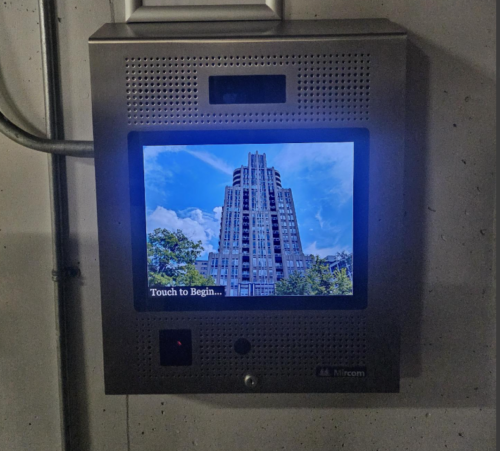
There are two separate systems at the front door of a multi-unit building. Entry is the panel a visitor uses to call a resident, known variously as a buzzer, an intercom, a telephone entry system or a door station. Access control is the reader that lets residents and staff in with a fob, card or phone credential. Entry handles people you do not know. Access control handles people you do.
Almost every quote confusion traces back to this. A property manager asks for a price on “a new buzzer system” and receives three quotes covering different scopes, because one supplier priced entry only, one priced entry plus readers on the main door, and one priced readers on every common door in the building.
The practical version: entry is one panel at the main entrance and possibly a second at the parking level. Access control is a reader at every door you want credentialled, which typically means the main entrance, the parking entrance, the amenity rooms, the storage area and the mechanical room. The reader count, not the panel, is what moves the price.
What a multi-unit building actually needs at the front door
A typical multi-unit residential building needs four things at its entrances: a way for visitors to reach residents, a way for residents to get in without a key, a way for staff and trades to get in on a schedule, and a record of what opened when. A building that has the first two and neither of the last two is the most common situation we walk into.
Deliveries have changed this in the last few years more than anything else. A courier arriving at a building with no delivery provision either buzzes random units until someone lets them in, which defeats the entry system entirely, or leaves the parcel outside. Neither is what the building intended, and both are worth designing around rather than accepting.
The audit trail matters more than most owners expect until the first time they need it. When a resident reports something missing from a storage locker, the question is who opened the storage room door and when. A system with credentials answers that in a minute. A system with keys cannot answer it at all.
The turnover problem, and why keys lose to credentials
Keys fail in rental buildings because a key cannot be revoked. When a tenant moves out without returning a key, the only way to restore security to that door is to rekey the lock and reissue keys to everyone else who uses it. A credential is revoked in the software in seconds, and nobody else is affected.
That difference compounds across a portfolio. One rekey after one move-out is an annoyance. A hundred units turning over at whatever rate your buildings run is a recurring cost that never appears as a line item because it is buried in locksmith invoices and staff hours.
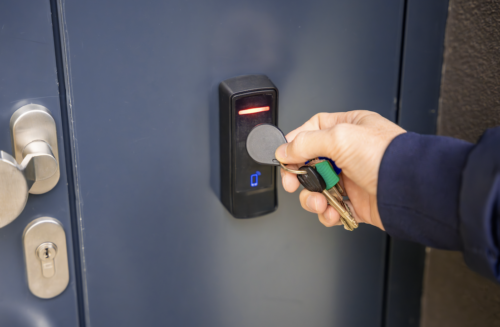
Credentials also fail gracefully. A resident who loses a fob gets that fob deactivated and a new one issued, and the lost one is worthless to whoever finds it. A resident who loses a key hands a stranger unlimited access to a door until somebody notices and pays to change it.
The management side is the part that decides whether this works in practice. If updating a credential means calling a service technician, the system will drift out of date within a year, because nobody books a service call for one move-out. If the property manager can do it from an office, the system stays current. That capability is worth asking about specifically, because it is the difference between a system that works in year five and one that quietly stops reflecting who actually lives in the building.
What drives the cost of an entry and access system
Entry and access pricing in New Brunswick is driven by door count and cabling condition rather than by the panel itself. The lobby panel is a relatively fixed cost. Every additional credentialled door adds a reader, a controller position, a lock or strike, and the labour to get power and data to it, and that is where quotes diverge.
What moves the capital number:
- How many doors you want credentialled, which is the single largest variable
- Whether usable cabling already runs to those doors, since fishing new cable through an occupied concrete building is the expensive part
- What kind of lock is on each door now, because some doors need new hardware before a reader is any use
- Whether the building has a functioning existing panel worth keeping as a head end
- New build or retrofit, since a building under construction takes cable for a fraction of what a finished one costs
What moves the recurring number: hosting or software subscription if the platform has one, service coverage, and credential supply as fobs get issued and lost.
Ask for capital and recurring separately, and ask what a fob costs before you need a hundred of them. QSA does this work across multi-site property portfolios, and the honest answer on price is that it comes from walking the building and counting doors, not from a rate card.
Retrofitting an occupied building
Retrofitting entry and access into an occupied residential building is mostly a sequencing problem rather than a technical one. The systems are well understood. What takes planning is doing the work without leaving residents locked out, propping doors open for a week, or running cable through finished ceilings in occupied corridors.
What existing cabling can carry
Older buildings often have more usable infrastructure than people assume. Mircom’s TX3 telephone access system, one of the platforms used in this market, supports three different connection approaches: dedicated subscriber telephone lines, a No Subscriber Line mode that uses the building’s existing telephone wiring without a separate phone service, and IP over Ethernet through add-on modules. Those options exist precisely because retrofits rarely arrive with ideal cabling.
That is worth establishing before anyone quotes a rip and replace. A building that cannot take one approach can frequently take another, and the difference in cost is substantial.
Phasing and resident communication
Sequence the work so every door is either fully on the old system or fully on the new one at the end of each day. Cut over the main entrance last, once residents already hold working credentials, so the busiest door changes when everyone is ready for it.
Tell residents before the credentials change, not after. The single most common complaint during an entry retrofit is not the disruption, it is a resident arriving home to a door their key no longer opens with no warning that it was coming.
What the Station House needed, and what it got
The Station House is an 80-unit condominium on Station Road in Fredericton, developed by Colpitts Developments. QSA installed Mircom TX3 telephone entry with card and fob access control and CCTV coverage across the building. The requirement was straightforward to state and harder to deliver: a building with substantial shared amenity space needed controlled access to all of it, and a property manager needed to run credentials without a technician.

The amenity list is the reason this building is a useful example. A rooftop patio, a two-floor fitness centre, social rooms, an indoor pool and hot tub, a woodworking shop, underground parking, storage units and a car wash all sit behind doors that need to distinguish residents from everyone else. Each one is a reader, and collectively they are most of the system.
Since commissioning, the systems have run with minimal service intervention, and property management has been able to handle credential updates directly as residents turn over. The full write-up is in our Station House project record, and other completed work is in our project showcase.
Where entry ties into the rest of the building
Entry and access control connect to three other building systems, and the connections are worth specifying at design time rather than discovering later. Access control ties to the fire alarm so that doors release on alarm. Video ties to the entry panel so a call can be seen as well as heard. Intercom and paging tie to common areas where announcements matter.
The fire interface is not optional and it is the one people get wrong. Electrically locked doors on an egress route must release when the fire alarm activates, and that interface has to be installed and verified rather than assumed. If you are replacing entry hardware on a building, the fire alarm side needs to be part of the conversation, not a separate project.
Video at the door has become more useful as camera behaviour has improved. QSA installed Alarm.com AI deterrence cameras at Beauceron Security’s downtown office, where cameras respond to someone in a defined zone rather than simply recording them. That was a commercial office rather than a residential lobby, but the same approach applies to a parking entrance or a rear door after hours. The full range sits under our security and access control work, and common-area audio under critical communications.
Managing several buildings on one platform
Running several buildings on one entry and access platform changes the job from managing systems to managing a standard. The gains are administrative rather than technical: one interface instead of three, one service relationship, one set of credentials, and one place a manager can look when a resident says their fob stopped working.
The obstacle is almost always inherited buildings. Each property arrives with whatever the previous owner or the cheapest available installer put in, and none of it talks to anything else. Consolidating does not have to happen at once, and it usually should not, but the standard should be decided before the next acquisition rather than after.
A practical sequence: decide the platform, apply it to the next building you touch for any reason, and convert the others as their existing hardware reaches end of life. That spreads the capital over years while ending the drift. Whoever holds the service and maintenance contract should be the same across the portfolio well before the hardware is, since that alone removes most of the coordination cost.
Coverage across New Brunswick
QSA Life Safety & Security installs and services entry, access control and video systems for multi-unit residential buildings across New Brunswick, including Fredericton, Moncton, Saint John, Miramichi and Edmundston, with technicians based in the region rather than dispatched into it.
The reason that matters for a residential building is response rather than installation. An entry system failure is a resident-facing problem within an hour, and how fast someone arrives is a service question. QSA has worked in Atlantic Canada for over 50 years with more than 1,000 systems installed, and employs 20-plus certified in-house technicians rather than subcontracting the call. If you want the building walked rather than a number over the phone, get in touch.
Frequently asked questions
Can we keep our existing wiring when we replace a buzzer system?
Often yes. Telephone entry platforms such as Mircom’s TX3 support several connection methods, including a mode that uses the building’s existing telephone wiring without a dedicated phone line, and IP over Ethernet where network cabling exists. Have the existing infrastructure assessed before accepting a quote that assumes full recabling.
What happens when a resident loses a fob?
The lost credential is deactivated in the system and a replacement is issued, usually within minutes and without affecting any other resident. The lost fob stops working immediately, which is the central advantage over keys. Ask what a replacement fob costs and who is permitted to issue one before you choose a platform.
Do buzzer systems still need a dedicated phone line?
Not necessarily. Older installations used a dedicated telephone line, but current systems also support using the building’s existing telephone wiring without separate phone service, or running over the building network. Which option suits a given building depends on the wiring already in place and what the building pays for phone service now.
Who pays for entry system upgrades, the landlord or the tenant?
Building entry and common-area access systems are part of the building rather than the rental unit, so they are normally the owner’s cost. Specific obligations depend on the lease and, in a condominium, on the declaration and bylaws. Confirm the split in writing before work starts.
Are smartphone credentials better than fobs?
Neither is universally better. Phone credentials remove the cost of issuing physical fobs and are convenient for younger residents. Fobs work without a charged phone, an app or a data connection, which matters for older residents and for staff. Most buildings run both rather than choosing.
Can several buildings run on one system?
Yes, and it is usually worth doing. Multiple buildings on one platform give a manager a single interface, one credential set, and one service relationship. The practical constraint is inherited hardware, so most portfolios standardize gradually as existing systems reach end of life.
What makes a door ready for a card reader?
A reader needs power and data at the door, a lock or strike that can be released electrically, and a door and frame in good enough condition to close and latch reliably every time. Doors that do not latch properly are the most common reason an access system underperforms after installation.