Commercial Security Systems in New Brunswick: What a Business Actually Needs
A commercial security system in New Brunswick usually means four things working together: intrusion detection, video surveillance, fire detection, and environmental monitoring for water and temperature. Most small businesses buy the first one, add cameras a few years later, and never connect the rest. This guide covers what each layer does, what drives the price, who is responsible when you lease, and how to phase it in without replacing what you already own.
We will use one worked example throughout: an independent bike shop. It is a useful case because it concentrates most of the risks a small commercial building faces. High-value stock sitting behind a glass front, customer property in for service, a workshop full of tools, and, since e-bikes arrived, a genuine fire consideration that did not exist ten years ago. If you run a different kind of shop, the systems are the same. Only the inventory changes.
What does a commercial security system in New Brunswick actually include?
A commercial security system is a set of connected detection and response layers rather than a single product. The four that matter for most New Brunswick businesses are intrusion detection at the doors and interior, video surveillance that can identify rather than just record, fire and smoke detection appropriate to what is stored on site, and environmental sensors for water and temperature.
The word “system” is doing real work in that sentence. A siren on the wall detects. A monitored system detects, verifies, and gets someone dispatched. Those are different products at similar-sounding prices, and the difference only becomes visible at two in the morning.
The other distinction worth understanding early is between equipment you own and service you subscribe to. Panels, cameras, sensors and cabling are a capital purchase. Monitoring, cellular communication, video hosting and service coverage are recurring. Quotes that bury the recurring side make the capital number look attractive and the five-year number considerably less so. QSA covers the full picture in our commercial security and access control work, and the systems we install come from Kantech, ICT, Axis, Genetec, Ajax and DSC.
Start with what you are actually protecting
Before comparing systems, put a number on what is inside the building overnight. A bike shop is a clear illustration: 60 to 100 bikes on the floor, e-bikes carrying four-figure price tags individually, a service department holding customer property the shop is liable for, and a workshop of tools that are trivially resaleable.
That last point is what changes the risk calculation. Inventory that is easy to move and easy to sell attracts a different kind of break-in than a shop full of large, traceable equipment. The October 2025 State of Retail panel in Bicycle Retailer puts smash-and-grab break-ins at the top of shop owners’ physical security concerns, alongside a pattern several owners described of teams working shop to shop, one person occupying staff while the other removes stock.
Do the same exercise for your own building. Count what is on the floor after close, note what is portable, note what belongs to a customer rather than to you, and note what would stop you trading if it disappeared. That inventory drives every decision below, and it is also the document your insurer will want. The same exercise applies to any commercial or industrial building where the contents are worth more than the fittings.
Why a basic alarm stops being enough
A basic alarm is a detection device with no verification and no guaranteed response. It reports that a contact opened or a motion sensor triggered, and it cannot distinguish a break-in from a delivery driver, a raccoon, or a mis-entered code. That ambiguity is what erodes response, both from monitoring stations and from police.
The practical consequence is a delay exactly when delay is expensive. A smash-and-grab is a short event. If the sequence runs siren, then a call to a keyholder, then a keyholder driving in to look, then a call to police, the shop has been empty of its best stock for some time before anyone with authority is on the way.
None of that makes basic alarms worthless. They deter opportunists and they satisfy most insurance minimums. But an alarm is the floor of a commercial system, not the whole of one, and the upgrade path from a working basic alarm is usually cheaper than owners expect because the wiring and panel often stay.
Intrusion protection: the three layers that matter
Effective commercial intrusion protection uses three layers rather than one: a perimeter layer at every opening, an interior layer covering the high-value zones, and a communication path that survives someone cutting the phone line or the power. Systems that skip the second or third layer fail in predictable ways.
The perimeter layer
Contacts on every exterior door, glassbreak detection on the storefront, and sensors on any rear or service entrance. In a glass-front retail unit the storefront is the most likely entry point and the most commonly under-protected, because door contacts alone do nothing about someone coming through the window beside the door.
Overhead and roll-up doors deserve specific mention. A service bay or delivery door is often on a different alarm zone from the retail floor, or on no zone at all, and it is the entry point that leaves the least visible damage from the street.
The interior layer
Motion detection covering the routes between the entry points and the stock, and separate protection on whatever concentrates the most value. In a bike shop that means the e-bike display and the back stock room. In another retailer it might be a stockroom, a safe, or a server cabinet.
The interior layer is what turns a single trigger into a pattern. One sensor firing is ambiguous. A perimeter contact followed by two interior sensors along a path toward the stock room is not, and that sequence is what allows a monitoring station to act with confidence rather than call you first.
The communication path
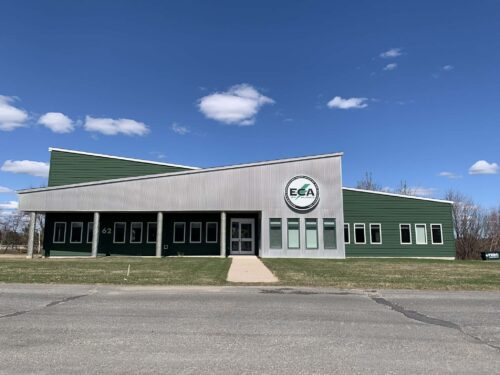
Panels that report only over a phone line or only over the building’s internet connection have one point of failure that is accessible from outside the building. Cellular communication with battery backup removes it. When QSA built the system at the Electrical Contractors Association of New Brunswick headquarters in Fredericton, the monitoring path was 24/7 with cellular backup for exactly this reason, alongside access control, intrusion and HD video on one platform.
Where video surveillance earns its cost
Video surveillance earns its cost in three specific ways: producing images good enough to identify a person rather than merely record one, verifying an alarm so police treat it as a crime in progress, and deterring an intrusion before it happens. Camera counts and megapixel numbers matter far less than which of these three jobs the system is designed to do.
Recording versus identifying
Most disappointing camera systems record perfectly well. The footage simply cannot answer the only question that matters, which is who this person is. Identification depends on pixels across the face at the point of entry, lighting at the times you are actually closed, and camera placement at head height on the approach rather than looking down from a ceiling corner.
A practical test: take last winter’s footage from your existing cameras at 11pm and see whether you could pick the person out of a lineup. If not, more cameras will not fix it. Better placement on two or three of them will.
Video verification and police response
Video verification links an alarm event to the footage from the moment it triggered, so a monitoring operator can see what caused it before deciding what to do. This converts an unverified alarm into a reported crime in progress, which is treated differently by most police forces and eliminates the false-alarm ambiguity that slows everything down.
For a shop with a short break-in window, this is the single highest-value upgrade available. It does not require replacing an existing camera system in every case, which is worth asking about before anyone quotes you a rip and replace.
Deterrence before entry
The newest layer is a camera that responds rather than watches. QSA installed Alarm.com AI deterrence cameras at Beauceron Security’s downtown office, where after-hours activity was the concern. The cameras use defined detection zones to trigger an automated voice response with strobe and siren when someone enters an area they should not be in, rather than waiting for a break-in to occur and be reviewed afterward.
That was a commercial office rather than a retail floor, but the situation transfers directly: a glass frontage, valuable contents visible from the street, and nobody on site after close. Other examples of how these systems get combined in practice are in our completed project work. The same approach protects outdoor stock, which is covered in our work on securing equipment yards and open sites.
Fire detection has changed, and lithium-ion is why
Fire detection in a retail or workshop building now has to account for lithium-ion batteries, which fail differently from the fires most standard smoke detection was designed around. Any business that stores or charges e-bikes, e-scooters, power tool packs or large battery inventory has a different risk profile than it had ten years ago, and usually the same detection.
The scale is documented. Ottawa Fire Services reported 54 fires linked to lithium-ion batteries between January 2024 and May 2026, five of them involving e-bikes or e-bike batteries, with 23 causing significant property damage. That is Ottawa rather than New Brunswick, and it is the closest published Canadian municipal dataset we have found. The trend is what matters: 19 fires in 2024, 25 in 2025, and 10 in the first five months of 2026.
What standard smoke detection misses
A lithium-ion cell in thermal runaway produces heat and vented gas quickly, and it can reignite after appearing to be out. Detection placed for a general retail floor may not be positioned near where batteries are actually charged, which in most shops is a bench in the back or a corner of the workshop rather than the open floor the detectors were laid out for.
The fix is usually not a new fire system. It is heat and smoke detection placed where the charging actually happens, tied into the same monitored panel as everything else. The ECANB installation used 16 heat and smoke detectors integrated with the security platform, which is the model: one system, one monitoring path, one place to check. Our fire and environmental detection work covers the code side of this.
Charging and storage worth reviewing
Separate the charging area from the main stock. Charge on a hard, non-combustible surface rather than on or near packaging. Avoid charging overnight when nobody is in the building. Set aside damaged or swollen batteries away from stock rather than leaving them on the bench. None of this requires capital spend, and all of it is worth writing into your closing routine.
Water and environmental monitoring: the quiet losses
Water and temperature losses damage more small commercial buildings each year than break-ins do, and almost none of them are detected until someone opens the door in the morning. A leak sensor and a temperature sensor on the same monitored panel as the alarm cost very little and cover a risk most owners have never priced.
New Brunswick winters make this concrete. A pipe in an unheated stockroom, a failed hot water tank, a roof leak over a stock shelf, or a furnace that quits on a long weekend all produce the same result: a building nobody is in, a problem nobody knows about, and a Monday morning discovery.
Environmental monitoring also protects things that are not obviously fragile. Humidity affects electronics, leather, and anything with bearings. Temperature swings affect adhesives and battery chemistry. If you hold stock that has a manufacturer’s storage specification, a sensor logging that you met it is worth having when a warranty claim gets argued.
If you lease your space: who is responsible for what
In a leased commercial space, the building systems are typically the landlord’s responsibility and the contents and business systems are the tenant’s, but security and life-safety equipment often falls in a grey area that neither party has read the lease closely enough to settle. Sort this out before you buy anything, because it determines who owns the equipment when you move.
The questions worth answering in writing: who owns and maintains the fire alarm system serving the unit, whether you are permitted to run cable or mount devices on demised walls, who holds the monitoring contract, what happens to installed equipment at the end of the term, and whether the landlord requires notification before work starts.
For landlords and property managers reading this from the other side, the same logic applies across a portfolio. Consistent systems across multiple tenancies mean one monitoring relationship, one service contract, and one place to look when something triggers, which is the approach behind our work in property management and multi-site portfolios.
What changes when you run more than one location
Running two or more locations changes the requirement from a system to a standard. The gains come from consistency: one monitoring platform, one set of user credentials, one service relationship, and one interface where a manager can see all sites rather than logging into three different apps from three different installers.
The most common problem in multi-site retail is inherited systems. Each location arrives with whatever the previous tenant or the cheapest local installer put in, and nothing speaks to anything else. Consolidating does not have to happen all at once, but the standard should be decided before the next location opens rather than after. Getting a single service and maintenance relationship across the sites is usually the first consolidation worth making.
Access control becomes worth its cost at this point too. Keys walk, and rekeying several locations after a departure is expensive. Credentials that can be revoked centrally in a minute cost less over any reasonable period, and they produce a record of who opened which door when, which resolves the questions that keys never can.
What a commercial security system costs in New Brunswick
The honest answer is that commercial security pricing is driven by building specifics rather than by list prices, so any figure quoted before someone has walked the building is a guess. What you can do is understand the variables that move the number, which lets you compare quotes properly and spot the ones that are cheap because something has been left out.
What drives the capital cost: the number of openings to protect, the number of cameras and the resolution and lighting conditions at each, whether usable cabling already exists, whether the building has a functioning panel worth keeping, ceiling and wall construction, and whether work has to happen outside business hours.
What drives the recurring cost: monitoring, cellular communication, video storage and how long you retain it, and the service level you want when something fails. Ask for capital and recurring separately, and ask for the five-year total. Two quotes that look 20 percent apart on equipment can invert once monitoring is included.
Where to start if the budget is staged: fix the communication path first, because a system that cannot report is not a system. Then video verification on the existing cameras if they are salvageable. Then the interior detection layer. Then fire and environmental sensors on the same panel. Cameras usually feel like the urgent purchase and are usually the one that can wait a quarter.
Coverage across Atlantic Canada
QSA Life Safety & Security installs and services commercial security systems across New Brunswick, Nova Scotia, Prince Edward Island and Newfoundland and Labrador, with technicians based in the region rather than dispatched into it. In New Brunswick that includes Fredericton, Moncton, Saint John, Miramichi and Edmundston.
The reason to care about where the technicians are is service, not sales. A system is only as good as the response when a device fails, and a company with 20-plus certified in-house technicians handles that differently from one that subcontracts the call. QSA has been doing this work in Atlantic Canada for over 50 years, with more than 1,000 systems installed. If you want the walkthrough rather than a phone quote, get in touch and we will look at the building.
Frequently asked questions
Will a monitored alarm system lower my commercial insurance premium?
Often, but the size of the reduction depends on your insurer and your policy rather than on the system alone. Monitored intrusion and fire detection are the two that most commonly affect commercial premiums. Ask your broker what evidence they need before you buy, because some insurers require specific certification or a monitoring certificate.
Do I need to register a monitored alarm with police in New Brunswick?
Alarm registration and false alarm penalties are set municipally rather than provincially in New Brunswick, so the requirement depends on where your business is located. Check with your local police force before your system goes live. Your monitoring provider can usually tell you what applies in your municipality.
Can I keep my existing cameras and add monitoring or verification?
Often yes. Whether existing cameras can be brought onto a monitored or verified platform depends on the recorder, the camera resolution, and how they connect to the network. It is worth asking specifically before accepting a quote that replaces everything, because salvaging usable cameras can materially change the capital cost.
How long should a business keep video footage?
Thirty days is a common retention period for small commercial sites and is usually enough for an incident to be discovered and reported. Longer retention costs more storage. If you have a specific insurance or franchise requirement, that governs. Retention should be a decision you make rather than a default your recorder came with.
What happens if the power or internet goes out?
A properly specified commercial system stays online through both. Battery backup covers a power outage for a defined number of hours, and cellular communication carries the monitoring signal when the building’s internet connection is down. If your current system relies only on the building’s internet, that is a single point of failure worth closing.
Is a DIY system enough for a small retail business?
For a business holding significant inventory, generally no. Consumer systems are built for self-monitoring, rarely support video verification, often lack cellular backup, and are not usually accepted for commercial insurance requirements. They can be a reasonable stopgap for a very small operation, but they are not a commercial system.
Can one system cover intrusion, fire, water and temperature?
Yes, and it usually should. A single monitored panel handling intrusion, fire detection, leak sensors and temperature sensors gives you one monitoring relationship, one app, and one service contract. Splitting these across separate systems and vendors is the most common reason a business discovers a problem late.